

To track AI citations, ask the question your buyers ask, collect the source URLs each AI tool's answer cites, and check whether your page is among them. Then rerun the same question over time. Dashboards such as Ahrefs Brand Radar, the Semrush AI Visibility Toolkit, Peec AI, OtterlyAI and Profound report cited pages inside a subscription. Cite42 runs the check on demand through an API or MCP server, from $0.01 per AI tool, with no subscription.
Citations and mentions are separate measurements. An AI answer can name your company without linking to your site, or cite your page while recommending someone else. Citation tracking covers the second case: which pages the AI tools read and pointed to, and whether one of them is yours.
Cite42 publishes this guide. The two citation checks below ran through Cite42 on October 5, 2026, and their full source lists are in the evidence file. We researched the other tools from their official pages on October 6, 2026.
How to track which sources AI answers cite
- Write the buyer question, for example "What are the best SEO MCP servers for Claude and ChatGPT?"
- Pick the AI tools to check and, optionally, the page you want to see cited.
- Collect every source URL each answer cited and which AI tools cited it.
- Open the most-cited sources and note what kind of page each one is and what it answers.
- Rerun the same question on a schedule and compare.
Keep three questions apart in your notes: did the answer name your brand, did it cite your domain, and did it cite the specific page you care about? Each one leads to different work. A brand check answers the first, and a citations check with a watched URL answers the third.
Tools that track AI citations
When we asked the five AI tools "Which tools track the websites and URLs cited by ChatGPT, Claude and Perplexity?" on October 5, Profound was named in four of five answers, Ahrefs in three, and Semrush, OtterlyAI and Peec AI in two each. Here's how they handle citations, as of October 2026:
- AI tools covered
- ChatGPT, Claude, Gemini, Perplexity, Google AI Overviews
- Citation feature
- Every cited URL for your question, plus a watched-page lookup
- Pricing
- Pay per call, no subscription; $0.20 for all five
- AI tools covered
- AI Overviews, AI Mode, ChatGPT, Perplexity, Gemini, Copilot
- Citation feature
- Cited pages and domains across its prompt index
- Pricing
- Included prompts on paid Ahrefs plans; more as an add-on
- AI tools covered
- ChatGPT, Gemini, Perplexity, AI Overviews, AI Mode
- Citation feature
- "Which pages get cited most" in its Visibility Overview
- Pricing
- Per-domain subscription, billed annually
- AI tools covered
- ChatGPT, Perplexity, Gemini, AI Mode
- Citation feature
- Source analytics with domain and URL detail
- Pricing
- See current pricing
- AI tools covered
- ChatGPT, AI Overviews, Perplexity, Copilot; Claude, AI Mode and Gemini as add-ons
- Citation feature
- Link citation analysis
- Pricing
- From $29 a month for 15 prompts
- AI tools covered
- ChatGPT, Perplexity, Claude, Gemini, Copilot, AI Overviews and more
- Citation feature
- Citation analytics and sources cited across answers
- Pricing
- 7-day trial; Enterprise by quote
The dashboards run a saved prompt set on a schedule and add history, share of voice and team reporting. Cite42 suits raw citation data for a handful of questions, in your own code or inside Claude, without a monthly plan. The AI visibility tools comparison covers the dashboards in more depth.
Cite42: citation checks per call, with no subscription
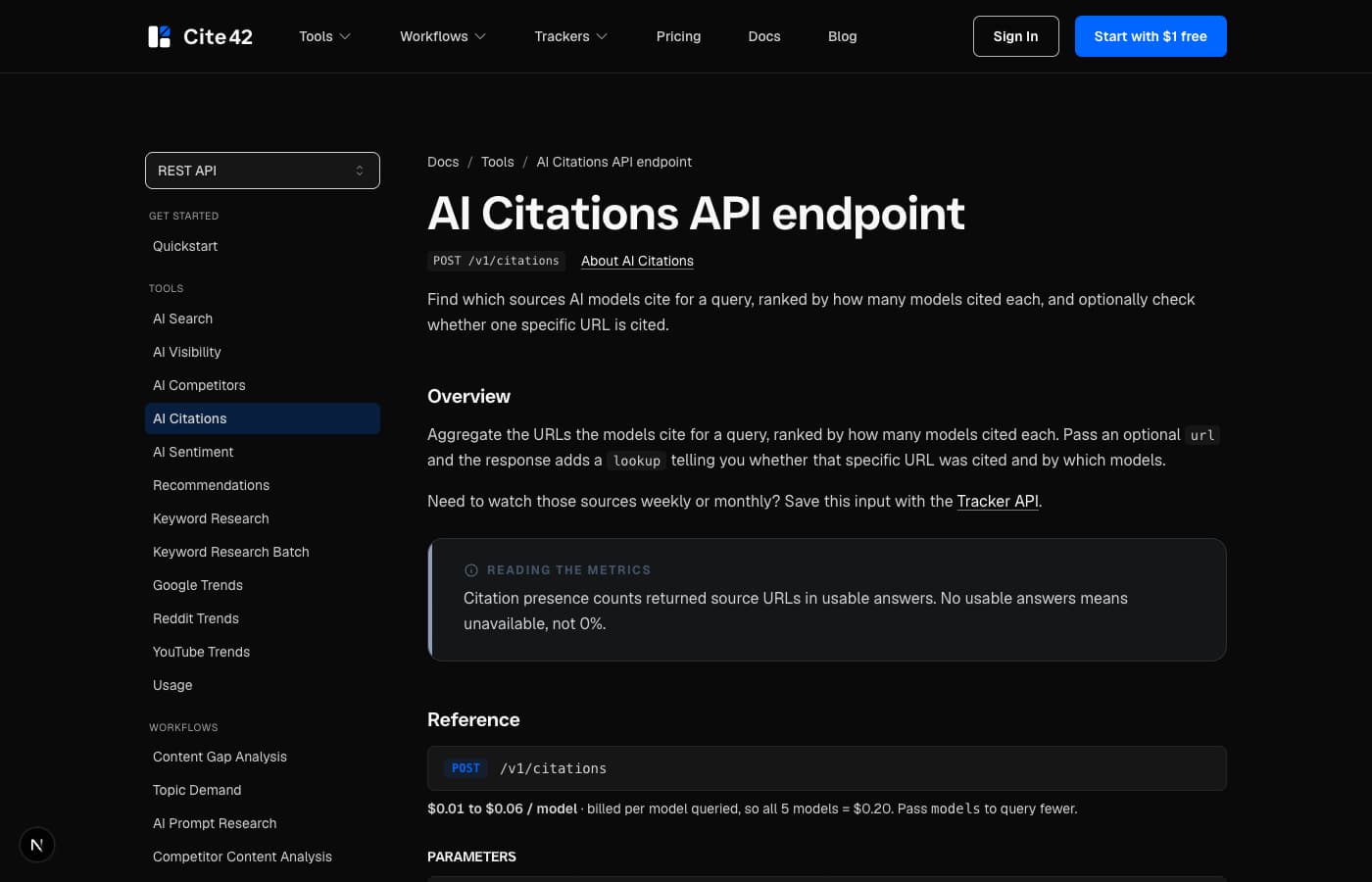
Cite42 is a pay-per-call API and MCP server for AI visibility. Its citations tool returns every source URL that ChatGPT, Claude, Gemini, Perplexity and Google AI Overviews cited for your question, and tells you whether a page you're watching was one of them. There is no subscription: you top up a prepaid balance (minimum $25.00), the balance never expires, and you pay only for successful calls. A verified signup adds $1.00 of free credit. A citations check costs $0.05 on ChatGPT alone, $0.08 on ChatGPT and Perplexity, and $0.20 on all five.
The response has three parts:
sources: each cited URL with its title,citedBy(the AI tools that cited it) andcount(how many of them did).lookup: when you pass a watchedurl,lookup.citedsays whether it was cited andlookup.citedBysays by which AI tools.measurement: which AI tools completed and how each one was queried.
The watched-URL lookup matches one page by host and path, ignoring the protocol, a trailing slash and query parameters such as ?utm_source=openai. The host must match exactly, so www.example.com and example.com count as different pages, and other pages on your domain show up only in sources. Gemini returns its sources as Google redirect links; Cite42 resolves them and adds the publisher's address as resolvedUrl before matching.
ChatGPT, Claude and Gemini are queried through their official APIs with web search enabled, Perplexity through its own search, and Google AI Overviews from live Google results. A consumer app may display citations differently from the sources its search returned. Cite42 keeps no historical index of AI answers, so you only see questions you or your trackers have run, and it leaves out Microsoft Copilot, Google AI Mode and Meta AI.
Check 1: which pages AI cites for "best SEO MCP servers"
We asked "What are the best SEO MCP servers for Claude and ChatGPT?" on all five AI tools and watched https://www.cite42.dev. All five answers completed, and the check cost $0.20.
- Result
- 37
- Result
- Contextbolt's SEO MCP server comparison, cited by Claude, Perplexity and Gemini
- Result
- Seven more pages, mostly "best SEO MCP servers" lists, including Keyword.com's and one from SE Ranking
- Result
- Five GitHub repositories and nothing else
- Result
- Cited by 0 of 5
For a comparison question, Claude, Perplexity and Gemini read comparison lists, and a vendor's own list (SE Ranking's) counted as one of them. ChatGPT went straight to GitHub. Gemini and Google AI Overviews also cited Reddit threads. A product that wants to be cited here has two routes: publish a comparison worth citing, and be listed accurately in the repositories and lists these answers already read.
Check 2: which pages AI cites for "Google Trends MCP servers"
We asked "What are the best MCP servers for accessing Google Trends data?" and watched https://www.cite42.dev/tools/google-trends. All five answers completed, for $0.20.
The answers cited 54 unique URLs, and the mix looked different. The HasData Google Trends MCP repository was cited by ChatGPT, Perplexity and Google AI Overviews. Most other sources were GitHub repositories, MCP directory listings on Glama, mcp.so, PulseMCP and mcpservers.org, and integration pages. Gemini also cited a Reddit thread in r/mcp. The watched feature page was cited by 0 of 5.
Perplexity returned 33 of those sources, and many were news articles that mention MCP or Google Trends in passing. Read a long source list with judgment: a listed URL shows what the search touched, and some of those pages had little to do with the answer.
Setup questions pull repositories and directories, so an article covers only part of what these answers read. That's why the Google Trends MCP guide includes working setup and real US and UK results, and why directory listings deserve the same care as the article.
Run a watched-page check yourself
Create an API key in the dashboard, store it as CITE42_API_KEY, and send a citations request. This one repeats our Google Trends check:
curl --fail-with-body https://www.cite42.dev/api/v1/citations \
  -H "Authorization: Bearer $CITE42_API_KEY" \
  -H "Content-Type: application/json" \
  -d '{
    "query": "What are the best MCP servers for accessing Google Trends data?",
    "url": "https://www.cite42.dev/tools/google-trends",
    "fullSweep": true
  }'
Read lookup.cited and lookup.citedBy first, then sources and measurement. A false lookup with five completed answers means the page was cited in none of them. If some AI tools failed, note how many answers the result covers.
For a cheaper check, replace "fullSweep": true with "models": ["chatgpt", "perplexity"], which costs $0.08 instead of $0.20. Keep the same AI tools when you compare dates.
With Cite42 connected to Claude, Claude Code or Codex (setup is in the Claude Code guide), ask in plain language:
Use Cite42 citations for:
"What are the best MCP servers for accessing Google Trends data?"

Watch https://www.cite42.dev/tools/google-trends.
Use ChatGPT and Perplexity.

Show whether the watched URL was cited and by which AI tools,
every cited source URL, and any failed checks.
Name the citations tool in the request. An assistant asked to "find citations" on its own will run its own search, which measures something else.
Turn the source list into content decisions
Open the most-cited sources and write down what each one is: a comparison, a repository, documentation, a forum thread or a product page. Then note which question it answers well and which it leaves open. A repository might give an install command and skip cost or what the numbers mean, while a listicle covers features and skips setup.
That open question is your page. Write the version that answers it with real examples and current facts, and keep your notes separating what you saw ("this repository was cited by three AI tools") from what you concluded ("readers need a setup guide"). The content gap analysis case study walks through this process from start to finish.
Track citations over time
A citations tracker reruns the same questions with the same watched URL weekly or monthly and keeps every run. Each tracker holds one measurement type, so create a separate rankings tracker if you also want brand mentions. For one question on all five AI tools, four runs cost $0.80 at current prices. The AI visibility tracking guide covers creating and activating trackers.
When a watched page does appear, read the answer and the source before calling it a win. A model update or a shift in search results can move citations too, and an immediate repeat call can return a cached result instead of a new sample.
Frequently asked questions
Which tools track the websites and URLs cited by ChatGPT, Claude and Perplexity?
Ahrefs Brand Radar, the Semrush AI Visibility Toolkit, Peec AI, OtterlyAI and Profound track cited sources in monitoring dashboards sold by subscription. Cite42 returns the cited URLs for any question on demand through an API or MCP server, covering ChatGPT, Claude, Gemini, Perplexity and Google AI Overviews, with no subscription. Coverage differs by tool: Claude is standard in some dashboards and an add-on in others, and Cite42 leaves out Copilot and Google AI Mode.
How do I check if my website is cited by ChatGPT?
Run a citations check with ChatGPT selected and your page as the watched URL. Cite42 returns lookup.cited (true or false) and every URL ChatGPT cited for that question, for $0.05 per check. Use the exact question your buyers ask, because a different question cites different sources.
What's the difference between an AI citation and a brand mention?
A mention is your brand's name appearing in the answer text. A citation is a source URL the answer drew on or linked to. An answer can mention you without citing your site, or cite your page while recommending a competitor, so track the two separately.
Is there an AI citation tracking tool without a subscription?
Yes. Cite42 charges per successful call with no subscription or monthly fee, and a citations check across ChatGPT, Claude, Gemini, Perplexity and Google AI Overviews costs $0.20. You top up from $25.00, the balance never expires, and a verified signup includes $1.00 of free credit.
Why do ChatGPT and Perplexity cite different sources for the same question?
Each AI tool runs its own web search and picks its own sources. In our SEO MCP check, ChatGPT cited only GitHub repositories, while Claude, Perplexity and Gemini mostly cited comparison articles. Check each AI tool your buyers actually use.
Check one page today
Create a free Cite42 account for $1.00 of credit, pick one buyer question and the page you want cited, and run the request above. The AI citations tool page and the citations API reference have the details.