

If you need AI visibility data in your own code, there are three kinds of API to pick from. Cite42 runs your own prompt live across ChatGPT, Claude, Gemini, Perplexity and Google AI Overviews and charges per call, with no subscription. DataForSEO and SE Ranking sell pay-as-you-go access to large databases of AI answers they have already collected. SerpApi and SearchApi return raw Google AI Overviews for you to analyze, and enterprise platforms such as Scrunch export data from a monitoring subscription.
The right choice comes down to one question: do you need an answer to your prompt today, or a big history of answers someone else collected? This guide compares the options on what they return, which AI tools they cover, what they cost and how much you still have to build.
Cite42 publishes this guide, and the request examples use Cite42. We researched the other APIs from their official documentation and pricing pages on October 5 and 6, 2026, and did not run paid tests through them.
The best AI visibility APIs for different jobs
- Cite42: live brand-mention and citation checks on your own prompts across five AI tools, billed per call with no subscription. The same tools work over MCP in Claude, ChatGPT, Codex and Cursor.
- DataForSEO: searching a database of hundreds of millions of collected ChatGPT and AI Overview answers by keyword or domain.
- SE Ranking: share-of-voice and competitor research from a prompt database that covers Google AI Mode and Gemini as well as ChatGPT and Perplexity.
- SerpApi and SearchApi: collecting raw Google AI Overviews cheaply when you will build brand detection yourself.
- Scrunch: pulling metrics and full answers out of an enterprise monitoring program.
Comparison at a glance
- What it returns
- Live answers to your prompt: brand mentions, positions, cited sources, sentiment
- AI tools covered
- ChatGPT, Claude, Gemini, Perplexity, Google AI Overviews
- Pricing (October 2026)
- Pay per call, no subscription; $0.20 for all five; $25.00 minimum top-up
- What it returns
- Brand and keyword mentions from a database of collected answers
- AI tools covered
- ChatGPT and Google AI Overviews (LLM Mentions)
- Pricing (October 2026)
- $0.10 per request plus $0.001 per row; $50 minimum payment
- What it returns
- Mentions, citations and share of voice from a prompt database
- AI tools covered
- Google AI Overviews, AI Mode, Gemini, ChatGPT, Perplexity
- Pricing (October 2026)
- Pay-as-you-go credits from $50 for 250,000
- What it returns
- Raw Google AI Overview text and sources
- AI tools covered
- Google AI Overviews
- Pricing (October 2026)
- 250 free searches a month; $25 a month for 1,000
- What it returns
- Structured AI Overview text and reference links
- AI tools covered
- Google AI Overviews
- Pricing (October 2026)
- $40 a month for 10,000 searches
- What it returns
- Metrics and full responses from your monitoring program
- AI tools covered
- Set by your Scrunch plan
- Pricing (October 2026)
- Enterprise Data API; custom quote
Pricing sources are linked in each section below. A per-call price, a minimum deposit and a monthly plan pay for different things, so compare them against the workload you actually expect.
Live checks or a database: choose this first
A live check sends your exact question, such as "What AI visibility APIs work without a subscription?", to the AI tools now and tells you what they said. It suits your own buyer prompts, a new product nobody has measured yet, or a client audit. Cost grows with prompts × AI tools × dates.
A database lookup asks "where does example.com appear?" and searches millions of answers collected earlier. It's good for discovering prompts you would never have thought to test and for share-of-voice across a whole category. The catch is that your exact question may not be in the database, and the answers can be weeks old.
A raw search API gives you Google's AI Overview and leaves brand detection, storage and reporting to you. It's the cheapest way to watch Google at scale, and it covers Google only.
Plenty of teams use two of these together: a database for discovery, then live checks on the 10 to 30 prompts that matter most.
Cite42: pay-per-call checks on your own prompts
Cite42 is a pay-per-call API and MCP server for AI visibility. You send a prompt and a list of brands, pick any of ChatGPT, Claude, Gemini, Perplexity and Google AI Overviews, and get back which brands each answer mentioned, in what order, and which sources it cited. There is no subscription: you top up a prepaid balance (minimum $25.00), the balance never expires, and you pay only for successful calls. A verified signup includes $1.00 of free credit.
Each AI tool is priced separately, from $0.01. A rankings or citations check costs $0.05 on ChatGPT alone, $0.08 on ChatGPT and Perplexity, and $0.20 across all five. The pricing page lists every tool.
What you can call:
- Rankings: mention rate and average first-mention position for each brand, broken down by AI tool.
- Citations: every source URL the answers cited, and whether a page you're watching appears.
- Sentiment and comparisons: how the answers describe a brand, and head-to-head comparisons against named rivals.
- Trackers: a saved list of up to 30 prompts that reruns weekly or monthly and keeps the history.
The same account also covers keyword volume and Google Trends. ChatGPT, Claude and Gemini are queried through their official APIs with web search enabled, Perplexity through its own search, and Google AI Overviews from live Google results. Like every tool here, these answers can differ from what a signed-in person sees in the consumer app.
Pros
- Runs your exact prompt today on five AI tools, including Claude, which DataForSEO's LLM Mentions and SE Ranking don't cover.
- No subscription or monthly minimum. A one-off audit of a few prompts costs well under a dollar per prompt.
- REST and MCP share the same tools, so a check you try in Claude can move into your code unchanged.
Cons
- No historical answer database: you only see prompts you or your trackers have run.
- Five AI tools. Microsoft Copilot, Google AI Mode and Meta AI aren't covered.
- Trackers run weekly or monthly. For daily data, schedule REST calls yourself.
Here is a full five-tool check for one buyer prompt. Keep your API key in an environment variable:
curl --fail-with-body https://www.cite42.dev/api/v1/rankings \
  -H "Authorization: Bearer $CITE42_API_KEY" \
  -H "Content-Type: application/json" \
  -d '{
    "query": "What AI visibility APIs can developers use without a monthly subscription?",
    "competitors": ["Cite42", "DataForSEO", "SE Ranking", "SerpApi"],
    "fullSweep": true
  }'
The response has a rankings entry per brand with mentionRate, avgPosition and a byModel breakdown, a sources list of cited URLs, and a measurement block recording how each AI tool was queried and whether it completed. When we ran this prompt on October 5, 2026, DataForSEO was the most-mentioned of the eight brands we tracked, named on three of the five AI tools. The tracking guide walks through that full 11-prompt baseline, and the raw responses are in the evidence file.
DataForSEO: mentions from a large answer database
DataForSEO's AI Optimization API includes an LLM Mentions API that searches a database of collected AI answers for a keyword or domain. On October 6, 2026 the product page reported more than 387 million prompts, covering ChatGPT and Google AI Overviews. The same API family adds AI keyword volume data and an LLM Responses API for sending your own prompts to models, which is priced separately.
LLM Mentions costs $0.10 per request plus $0.001 per returned row on pay-as-you-go billing. There is no subscription, but DataForSEO's pricing page sets a $50 minimum payment.
Pros
- A very large dataset, so you can find mentions for prompts you never thought to test.
- Low unit prices for high-volume pipelines.
Cons
- LLM Mentions covers ChatGPT and AI Overviews only.
- It's a lower-level data API: brand matching across your prompt set, storage and reporting are yours to build.
SE Ranking: share of voice from a prompt database
SE Ranking's AI Visibility API returns brand mentions, citation links, positions within answers and the prompts that triggered them across Google AI Overviews, AI Mode, Gemini, ChatGPT and Perplexity. Its research data comes from more than 25 million tracked prompts, refreshed monthly, and the page also describes daily tracking for prompts you choose. It can rank you against up to 10 competitors and separates linked from unlinked mentions.
Billing uses pay-as-you-go API credits. The API access page lists $50 for 250,000 credits, and the AI Visibility API page offers a 100,000-credit trial. Each operation uses a different number of credits, so convert your workload into credits before comparing.
Pros
- Covers Google AI Mode and Gemini as well as ChatGPT, Perplexity and AI Overviews.
- Share-of-voice leaderboards and linked or unlinked mention data come ready-made.
- The same account covers keywords, backlinks and site audits, plus a hosted MCP server.
Cons
- Research data refreshes monthly, so a new page or product can take time to appear.
- Credit use differs by operation, which makes costs harder to predict. There's no Claude coverage.
SerpApi and SearchApi: raw Google AI Overviews
SerpApi and SearchApi are search-result APIs. They return Google's AI Overview as structured data, and you decide what counts as a brand mention.
SerpApi's AI Overview API returns the overview text and its sources. When a normal search response doesn't include the full overview, you fetch it with a follow-up request using the returned page_token. Its pricing includes 250 free searches a month and a $25 Starter plan with 1,000 searches.
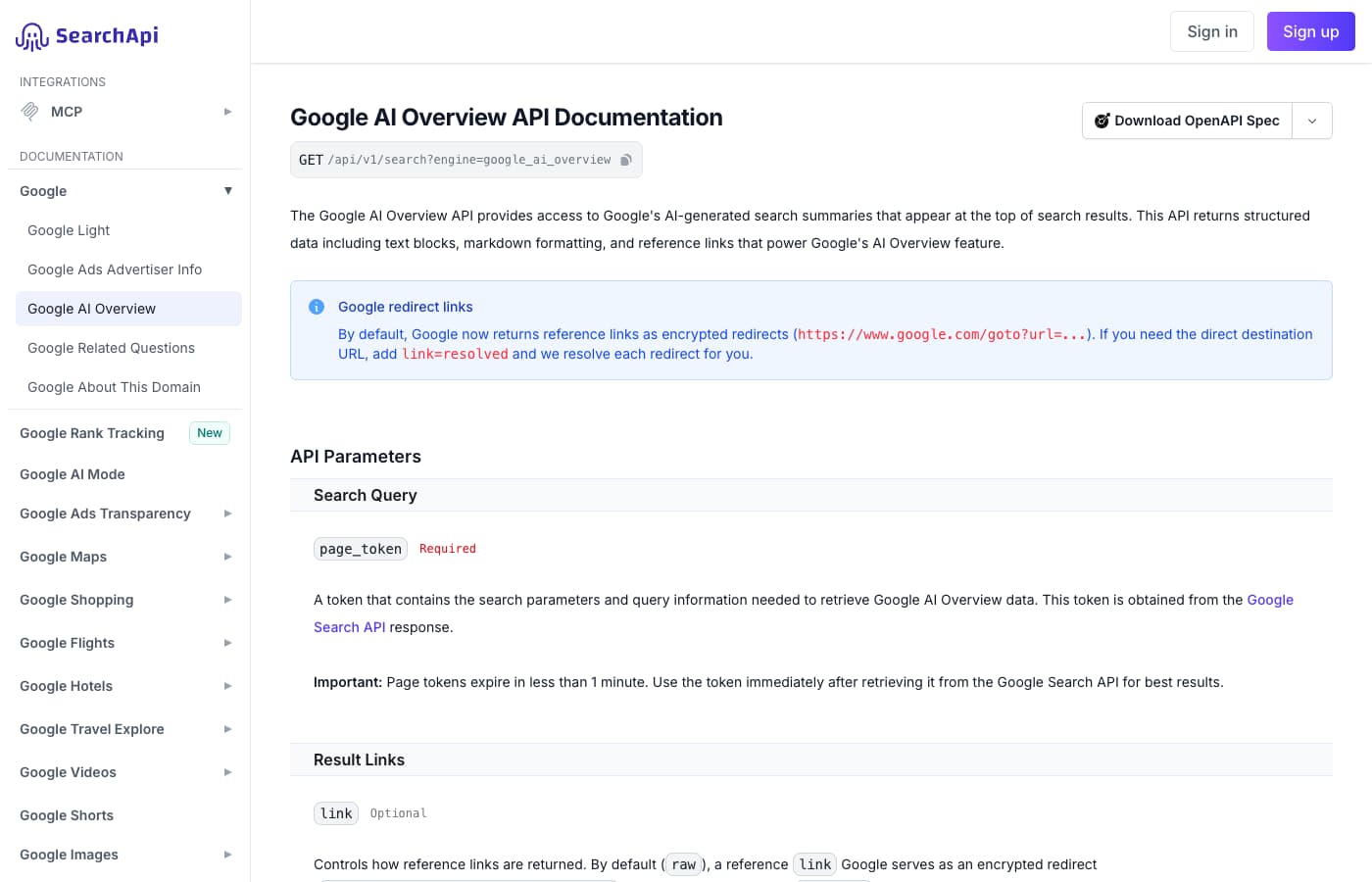
SearchApi's AI Overview API returns text blocks, Markdown and reference links, with an option to resolve Google's redirect links to the real destination URLs. Its follow-up token expires in under a minute, so fetch the overview in the same job. The Developer plan is $40 a month for 10,000 searches.
Pros
- The cheapest way to monitor Google AI Overviews across many queries.
- Full raw data, so your own scoring rules decide what counts.
Cons
- Google only, with no ChatGPT, Claude, Gemini app or Perplexity answers.
- You build brand detection, storage and reports. Not every query returns an AI Overview, so record "no overview" separately from "overview without your brand".
Scrunch: exporting data from a monitoring platform
Scrunch is an AI visibility monitoring platform with a Data API. Its API overview describes a Query API for aggregated metrics and a Responses API for full answers, sources, competitor presence and metadata. Billing follows the AI responses Scrunch collects for you, not the number of API calls, and Data API access sits in the custom-priced Enterprise tier on its pricing page.
Pros
- Full answer text and source URLs behind every dashboard metric.
- A clean way to sync a monitoring program into your data warehouse.
Cons
- Requires an enterprise contract.
- You're exporting an ongoing program rather than running one-off checks on demand.
What a small monitoring program costs
Take a reference workload: 20 buyer prompts, five AI tools, four check dates a month. That's 400 answers.
- Cite42: $16.00 a month for brand rankings, or $32.00 with a citations check on the same prompts.
- SerpApi or SearchApi: 80 searches plus any follow-up fetches fits inside SerpApi's free tier, but it covers Google only and you build the reporting.
- DataForSEO or SE Ranking: cost depends on how many rows or credits your lookups return, and your 20 prompts may or may not be in their databases.
- Scrunch: ask for a quote based on your prompt count, engines and retention.
The Cite42 figures are calculated from current prices for a four-run month, not a recorded bill.
Store results so you can compare them later
Whichever API you pick, a few habits keep next month's numbers comparable with this month's:
- Save the exact prompt, the AI tool, the date and how the answer was collected with every result.
- Store a failed check separately from an answer that didn't mention you. One failed AI Overview check in a five-tool run means four answers, not five.
- Version your prompt list. Adding branded prompts will raise your mention rate without anything else changing.
- Keep mentions, citations and sentiment as separate fields rather than blending them into one score.
- Don't treat an immediate repeat call as a new sample. Cite42 caches recent results, and a cached answer is the same observation, not a fresh one.
Frequently asked questions
Is there an AI visibility API without a monthly subscription?
Yes. Cite42 charges per successful call with no subscription: you top up from $25.00, the balance never expires, and a brand check across ChatGPT, Claude, Gemini, Perplexity and Google AI Overviews costs $0.20. DataForSEO and SE Ranking also sell pay-as-you-go access to their AI answer databases, with a $50 minimum payment at DataForSEO and credit packs from $50 at SE Ranking.
What is the cheapest way to track a brand in ChatGPT through an API?
For a few prompts, a pay-per-call live check is cheapest. Cite42 charges $0.05 for a ChatGPT-only rankings check. For thousands of data points, DataForSEO's LLM Mentions database ($0.10 per request plus $0.001 per row) can work out cheaper, but only for prompts already in its database.
Can I use an AI visibility API from Claude or ChatGPT?
Yes, through MCP. Cite42's hosted MCP server at https://mcp.cite42.dev gives Claude, ChatGPT, Codex and Cursor the same tools as its REST API. SE Ranking and OtterlyAI also run MCP servers; the AI visibility MCP comparison covers the differences.
Which AI engines do AI visibility APIs cover?
It varies by API. Cite42 covers ChatGPT, Claude, Gemini, Perplexity and Google AI Overviews. DataForSEO's LLM Mentions covers ChatGPT and AI Overviews. SE Ranking covers AI Overviews, AI Mode, Gemini, ChatGPT and Perplexity. SerpApi and SearchApi cover Google AI Overviews only.
How is an AI visibility API different from a SERP API?
A SERP API returns Google's results page, including any AI Overview, and leaves the analysis to you. An AI visibility API asks AI tools a question, or searches answers they have already given, and reports which brands and sources appear.
Try a check on your own prompt
Pick one question your buyers would ask an AI assistant, list your brand and three competitors, and run the request above. Create a free Cite42 account for $1.00 of starter credit, then grab an API key from the dashboard and the request details from the API documentation. If you'd rather work inside Claude or ChatGPT, the MCP comparison covers setup, and the AI visibility tools guide covers dashboard platforms.